
USFSS Newsletter, Issue No. 1 August 2026
Welcome from the USFSS Board Chair
Dan Hanks, USFSS Board Chair
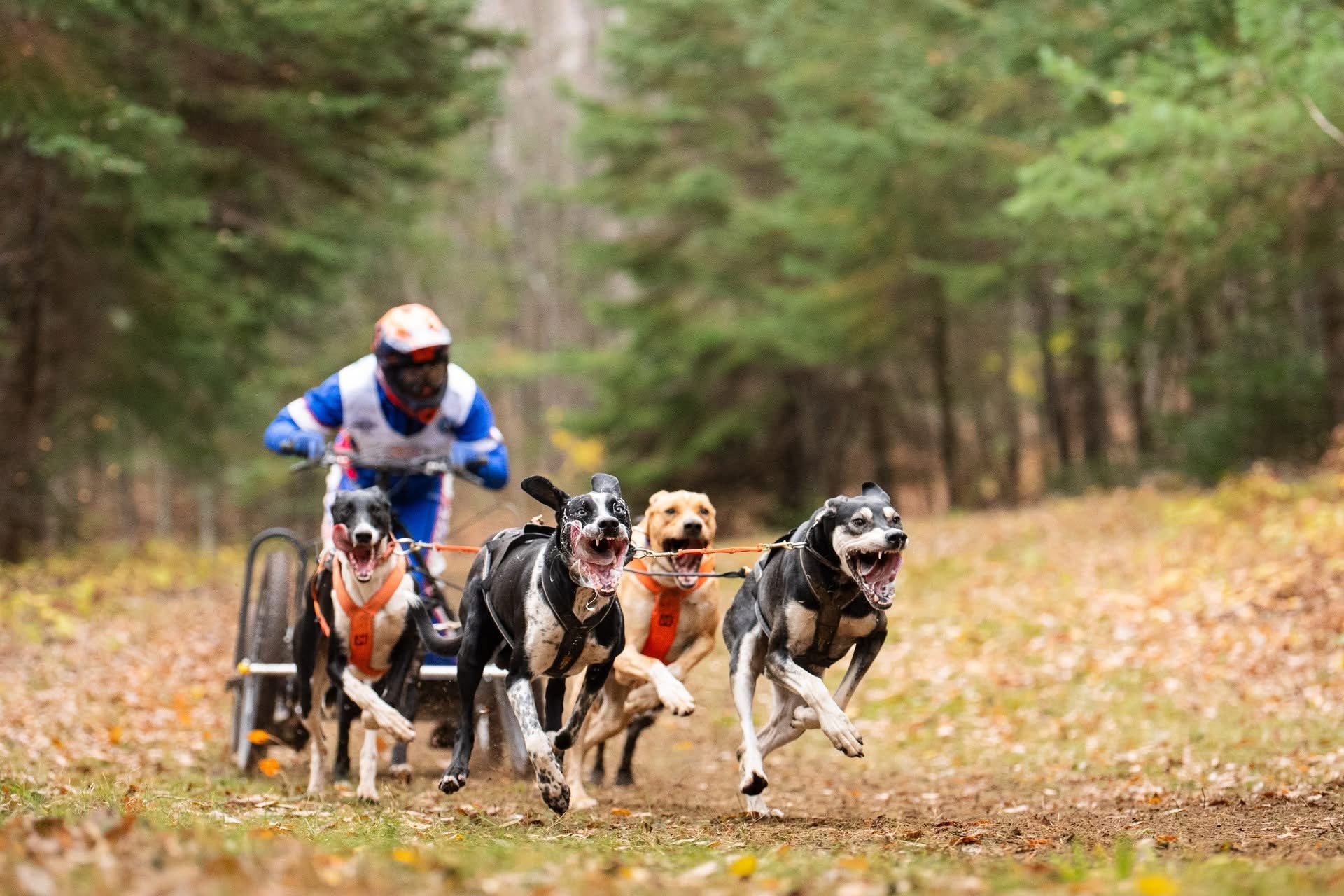
DanielT Photo
I am pleased to share with you the very first edition of our USFSS monthly newsletter. We expect to publish one each month and welcome members' feedback and contributions. Please feel free to send your suggestions to usfss.usa@gmail.com.
As we gear up for another thrilling season, I couldn't be more excited about what lies ahead for our USFSS community!
This year marks a significant milestone for our organization with the expansion of USFSS/IFSS-sanctioned races. In prior years, USFSS was only permitted to select 10 races for IFSS accreditation, and now we are able to select an unlimited number of races, as long as they meet accreditation requirements. This IFSS rule change gives our athletes across the entire country more opportunities to compete in IFSS-accredited races.
Another development worth noting is that we continue to expand our USFSS National Judge program and are providing training in Cle Elum, Washington this fall to train an additional 10 judges. We are working with our current National Judges to help them acquire full IFSS International Judge status. We have a few spots open, so please contact me at usfss.usa@gmail.com if you are interested in participating.
Perhaps most exciting is watching Team USA stretch across the globe this season. We currently have selected athletes planning to race in Poland, Mexico, and Finland. It’s incredibly rewarding to see our sport’s international footprint expanding and to have USFSS mushers competing at the highest levels worldwide.
I want to thank all our members, volunteers, race organizers, and sponsors who make this growth possible. Your passion and commitment to sled dog sports continue to push us forward.
Here's to being safe and having fun this upcoming season!
IFSS-Accredited Fall Dryland Races, as of August 1, 2026
-
Seeley Lake Dryland, September 26-27, Montana
-
Iron Paws World Cup Dryland, October 2-3-4, Washington
Northwest Dryland Championship, October 10-11, Washington
Byllesby Dryland Derby, October 17-18, Minnesota
Lost Pines Dryland Race, October 24-25, Michigan
Northwest Dryland Challenge, October 24-25, Washington
Osceola Tug Hill Dryland, October 31-Nov 1, New York
Minocqua Dryland Dog Dash, October 31-November 1, Wisconsin
-
Cherry Hill Dryland, November 7-8, Maine
Ethan Howard Memorial Rig Race, November 14-15, New Hampshire
Charlton Park Dryland Challenge, November 14-15, Michigan
Mandatory Race-Giving Organization (“RGO”) training:
Starting this fall, USFSS will require all RGOs for IFSS-accredited races to attend one of four virtual training sessions. RGOs will receive an email about the interactive trainings. They are designed to provide RGOs with critical information about updated IFSS rules and USFSS exceptions to those rules.
Volunteer Spotlight: Sylvain Lefebvre, IFSS Continental Director for North America
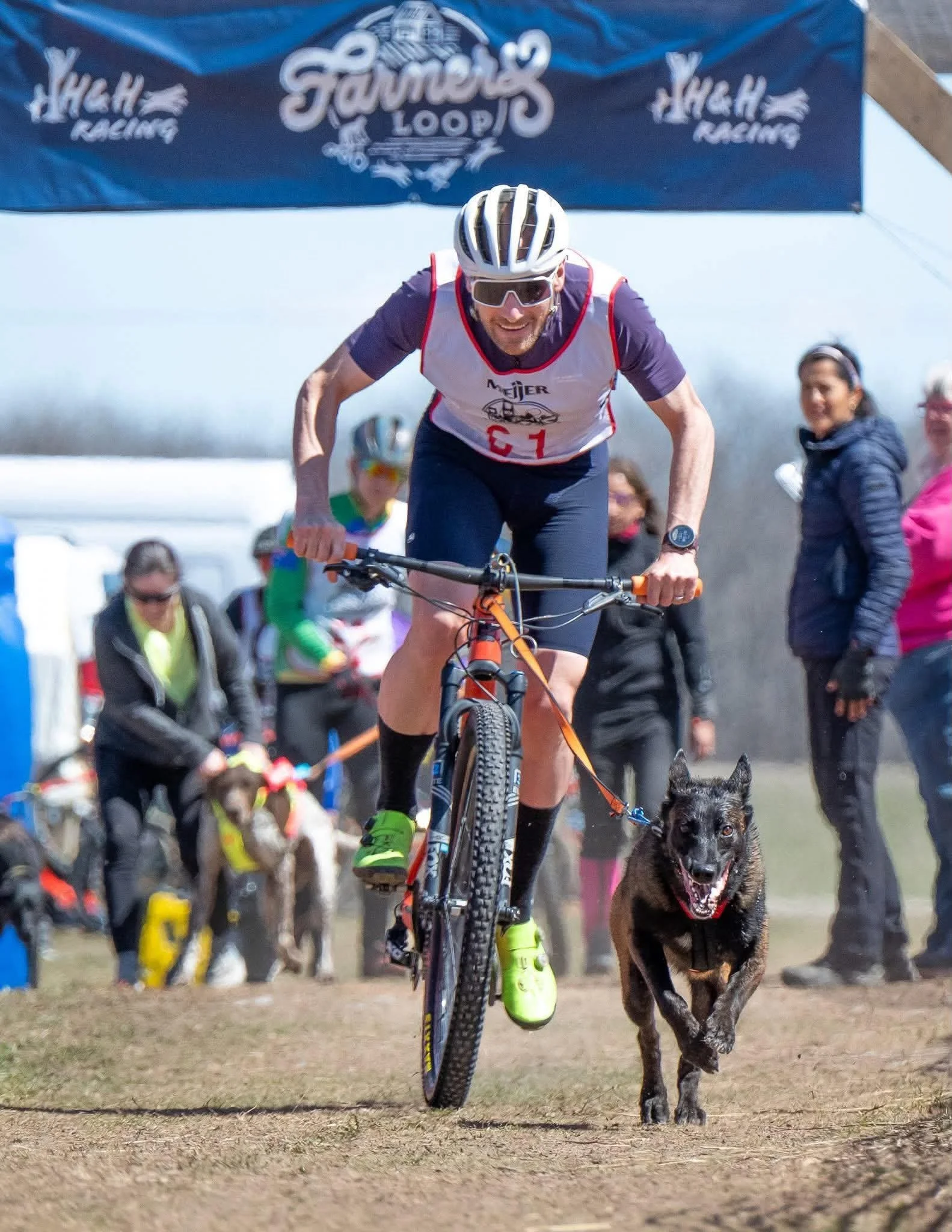
Sylvain racing with Zuma
Born in Connecticut, raised in Belgium, and I met my wonderful wife on the trails while working as an expat in Mexico. I have been involved in sled dog sports for 8 years as a competitor and since June 2023 have had the honor of serving on the IFSS Council as the Executive Director. This experience has given me a strong understanding of both local development and high-performance international competition. In 2025, I was elected as Continental Director of North America to represent USFSS and CAHDS on the IFSS council. Among the position’s various responsibilities, the Director solicits bids for Championships, organizes and promotes education efforts, and also races on the continent.
Professionally, I serve as President of the North American division of a sheet metal machine manufacturer, overseeing sales and service operations across the Americas. On the trails, I love to compete, but above all, I enjoy most the many months of training and preparation spent with my wife and our dogs.
Coaching Corner: Joy Weis, Lucky Fox Coaching
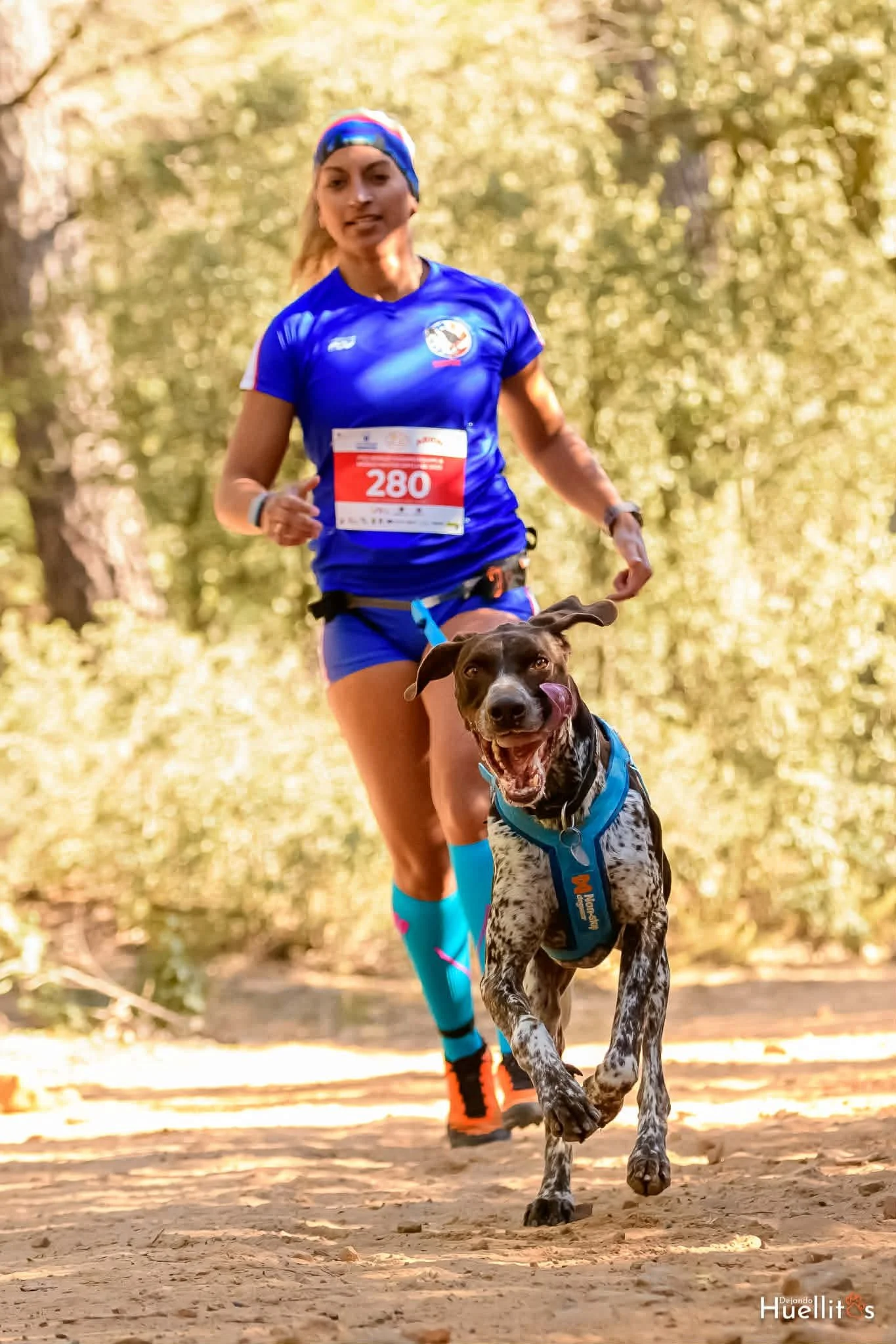
Joy racing with Pharoah
Summer training with dogs can often be challenging. Heat and humidity make longer runs or heavier training loads very risky. So, this is the season to shift gears and have fun! Summer provides us all with a chance to get out early and explore new trails, add swimming, and dial in basic skills work. This helps keep your dog active and mentally stimulated. Summer is also a great time to focus on building your own skills as a human athlete. The stronger and more capable you are, the better partner you’re able to be for your dog. You know your dog best, but it’s always worth the reminder: their health and well-being comes first every time.” -Joy Weis, Lucky Fox Coaching
At Lucky Fox Coaching, Joy works with high-performing endurance and canicross athletes. She’s certified through RRCA, USA Cycling, NASM, and Precision Nutrition, and coaches alongside her husband Nick. Joy also hosts No BS With Joy, a podcast that covers fitness, training, health, and wellness. A Team USA canicross athlete herself, Joy placed 10th at the 2025 IFSS World Championships. Outside of the fitness world, Joy is the founder and Executive Director of the Friends of Oso Foundation, supporting northern breed rescue organizations nationwide.
Ask a Vet: Dr. Ayla Mollen
One of the wild animals that many dog owners dread encountering with their canine is a porcupine. While it isn’t a big, snarling animal, its 30,000 quills can cause a leisurely walk in the woods to become an emergency visit to the vet’s office. We’ve asked Dr. Ayla Mollen to offer some insight into this prickly subject. Dr. Mollen currently works in emergency veterinary care, and as a Detection K9 Handler.
Q: What season do you see the most porcupine quill removals at the clinic?
A: Late spring and early summer seem to bring the highest number of porcupine quill encounters.
Q: Do you recommend that people always bring their dog in after a porcupine encounter?
A: Yes, it is recommended that people bring their dogs into a clinic after a porcupine encounter, especially if it is with a baby porcupine as these quills are harder to see and break more easily. Dogs are often pretty sore from the quills which can make removing them difficult at home.
Trying to remove quills at home with an uncooperative dog can result in breakage of the quills and result in what we call a "migrating foreign body." This means the part of the quill that was broken off and is still in the dog can migrate anywhere in the body and potentially cause a bad infection. Often dogs need sedation in clinic to properly assess their quill burden and successfully remove all of the quills.
Q: If dog owner is unable to get to a vet quickly, is there a way for people to safely remove quills at home? What tools do you recommend and what should you treat the area with afterward?
A: If there is not a nearby vet clinic or one that is open, it is recommended that owners try and put a cone on their dog to avoid further trauma if the quills are mostly in the face/mouth. Owners can try to remove the quills using hemostats, but it can be a very painful and tedious process. There is a risk of missing quills, quills breaking off or dogs trying to bite their owners because of the pain of the quills. Oral antibiotics would be recommended for quill encounters, but topical antibiotics can be used in place of oral antibiotics until they can be assessed at a clinic.
Q: Are there any illnesses dogs can get from porcupine quills?
A: Dogs can get infections from porcupine quills either from quills left behind or broken off and left under the skin. These can cause infections in any part of the body including in the chest, abdomen, and in rare cases the brain, if the quills migrate.
Q: Best ways to prevent porcupine encounters?
A: The best way to prevent porcupine encounters is to teach your dog a good "leave it" or recall command, as porcupine encounters often occur from a dog being in prey-drive and chasing after a porcupine. Making noise in the woods can also help scare off most wildlife including porcupines.
Q: Anything else you would like dog owners to know about porcupine encounters?
A: Porcupines don't shoot their quills (even the African porcupines don't). Dogs that end up quilled are always dogs that chase after the porcupines and try to grab them. Their quills are barbed and easily embed into the skin. The most common areas we find quills are the face, paws, and chest.
Athlete Spotlight: Lori Anne Johnson
Lori Anne didn’t set out looking for canicross, but what started with finding a companion dog eventually led to someone encouraging her to try dog-powered sports. Her initial response? “No thank you.”
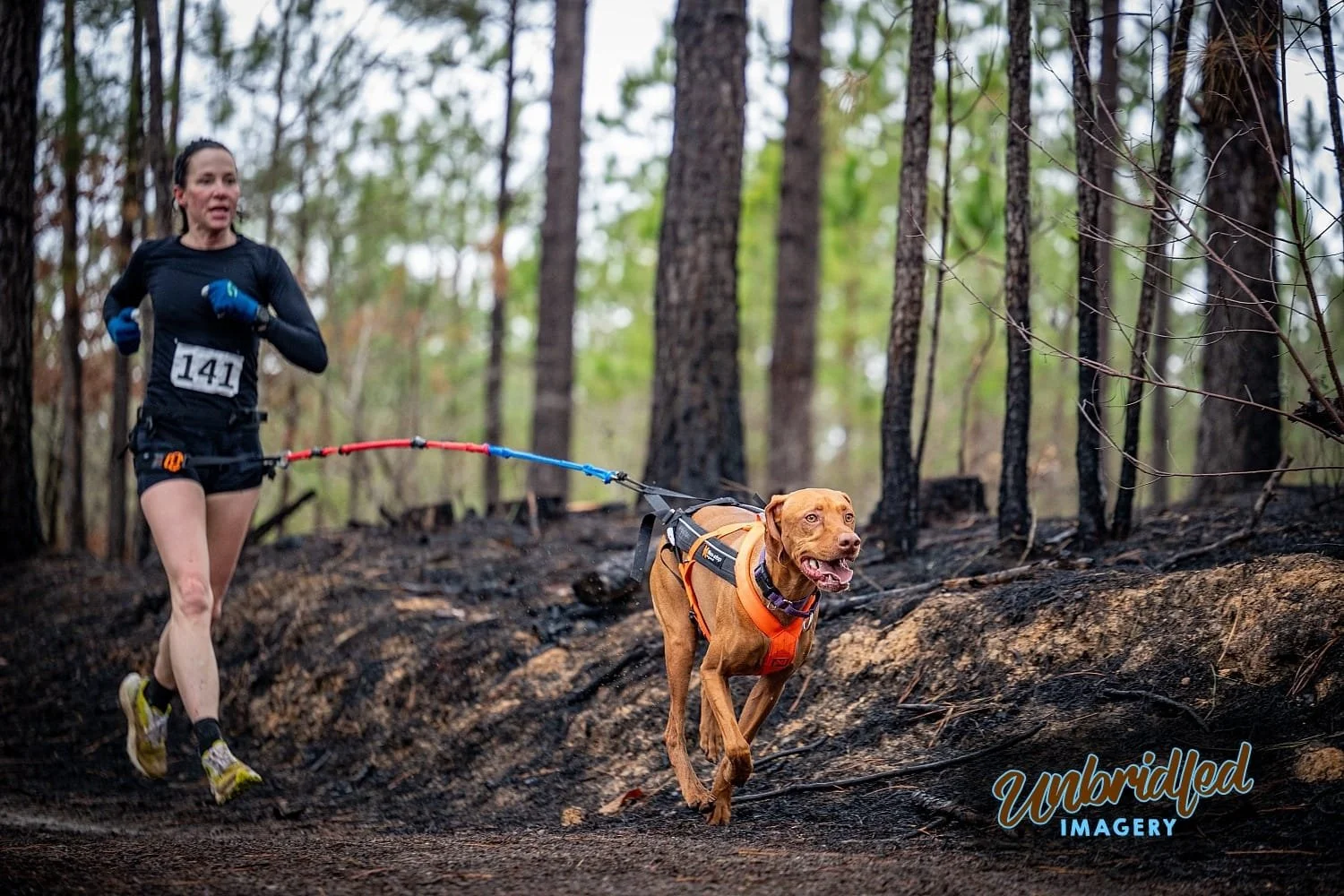
Unbridled Imagery
But after giving it a chance, she was hooked. Already an experienced runner, Lori Anne found that canicross challenged her in an entirely different way. “It’s really become a team sport,” she shared. “You’re constantly thinking about your dog, communicating, encouraging them, and working together.”
Today, Lori Anne trains with two very different canine teammates. Her experienced dog brings focus, determination, and power to the trail, while her younger dog is already showing impressive drive and athleticism. Learning how each dog works, and adapting her training to help them succeed, has become one of her favorite parts of the sport.
Her willingness to keep learning extends beyond her dogs. Over the years, Lori Anne has worked with running coaches, incorporated strength training, and shifted to a program designed specifically for canicross. She credits that consistency, along with having knowledgeable people to learn from, as a major reason she’s continued to improve.
That journey led to one of the biggest milestones of her career so far: representing Team USA at the 2025 IFSS Dryland World Championships. Looking back, Lori Anne describes the experience as both surreal and motivating. It showed her how far she had come while giving her a clear picture of where she wants to go next. “I’m 54 years old, so why can’t I compete with all these young people? That’s my challenge.”
Home: Minnesota Sport: Canicross Profession: Hairstylist
When she’s not training: She enjoys traveling, eating good food, and spending time exploring trails with her dogs.
Advice: For anyone interested in trying canicross, Lori Anne’s advice is simple: find a local community, ask questions, don’t worry about being fast, and don’t be afraid to start with a walk. Every team begins somewhere, and with the right support, you might just discover a new passion alongside your dog.
Watch the full Athlete Spotlight on the USFSS Team USA YouTube channel to hear Lori Anne share more about her journey into canicross, representing Team USA, and the lessons she’s learned along the way.
Club Spotlight on: Pennsylvania Sled Dog Club (PSDC)

Today the Pennsylvania Sled Dog Club (“PSDC”) has over 150 members from Pennsylvania, New York, Ohio, Delaware, Virginia, Connecticut, Rhode Island, Maryland, New Jersey, and Alaska.
The club sponsors numerous races, including the Tug Hill Challenge, its longstanding winter race in the beautiful Winona State Forest in New York; the Northeast Dryland Challenge in Pennsylvania; the Jersey Devil in New Jersey; and the Osceola Tug Hill Dryland Challenge in New York.
In addition to its races, the PSDC also hosts numerous social and training events during the spring, summer, and fall. This year, its fall training event will be held on October 16-18, 2026 at a new location: Fall Brook Farms in Geneseo, New York. PSDC is also pleased to announce that it will host the 2027 ISDRA Conference in Elysburg, Pennsylvania.
Please check the PSDC Facebook page for details and sign-up information about all club events.
Recipe for (Human) Road Warriors
Looking for a healthy meal amid the chaos of training, traveling, and racing? Planning food for humans is often the last thing on our mind. In this section, we plan to offer some healthy food options that either can be premade to pull out of the fridge or cooler, or can be heated up over a little butane grill or open fire. We hope you will try our first recipe:
Turkey Avocado Veggie Wraps
Pick your favorite wrap (flour tortilla, low carb, gluten free, etc.)
Fillings:
1 medium avocado (try mashing and adding the oil/vinegar into it)
halved cherry tomatoes
sliced cucumber
diced-up spinach
mayo or sour cream
sliced colored pepper red, yellow, or orange
oil and vinegar
2-3 slices of deli turkey (optional)
Cheese (optional)
Wrap the sandwich in plastic wrap and put in the cooler or fridge until you are ready to eat it. • Wrap it tightly to get out as much air out as possible in order to keep the avocado fresh. Enjoy!
